Adversarial Attack and Defense on Language Models

Overview Speaker: Ibrahim Al Azher Date: Friday, September 18, 2026, 2:30 PM Room: PM103 This session covers adversarial attacks on language models and the defenses against them, organized in three parts: attacks, defenses, and tool-based attack and defense. The reading list for each part is below. Relevant Materials Attack Universal and Transferable Adversarial Attacks on Aligned Language Models Improved Techniques for Optimization-Based Jailbreaking on Large Language Models Tree of Attacks: Jailbreaking Black-Box LLMs Automatically PANDORA: Jailbreak GPTs by Retrieval Augmented Generation Poisoning A Gradient Control Method for Backdoor Attacks on Parameter-Efficient Tuning FLASH: Focused Layer Attention Sink Hijacking Defense Safety Alignment Should Be Made More Than Just a Few Tokens Deep AGD: Adversarial Game Defense Against Jailbreak Attacks in Large Language Models Mitigating Fine-tuning based Jailbreak Attack with Backdoor Enhanced Safety Alignment AutoDefense: Multi-Agent LLM Defense against Jailbreak Attacks Defending Large Language Models Against Jailbreak Attacks via Layer-specific Editing Tool-Based Attack and Defense Same Payload, Different Channel: Measuring Trust Asymmetry in Tool-Using Language Models Mind the GAP: Text Safety Does Not Transfer to Tool-Call Safety in LLM Agents Prompt Injection as Role Confusion LLMs Encode Harmfulness and Refusal Separately When Safety Speaks a Language: A Mechanistic Analysis of Safety–Language Identity Entanglement in LLMs Refusal in Language Models Is Mediated by a Single Direction Attention Slipping: A Mechanistic Understanding of Jailbreak Attacks and Defenses in LLMs ASIDE: Architectural Separation of Instructions and Data in Language Models (ICLR 2026)
September 18, 2026 · 2 min · Ibrahim Al Azher

Recursive Self-Improvement (RSI) in AI

Overview Speaker: Lei Zhang Date: Friday, September 4, 2026, 2:30 PM Room: PM103 Recursive self-improvement is one of the more plausible candidates for the next big thing in AI, and the real technical pivot under most AGI-timeline arguments. The system applies itself to itself. The essential move is self-application, which is why you can’t discuss RSI without fixed points. But “fixed point” here is three different things: Kleene’s second recursion theorem The Y combinator x* = f(x*) They don’t substitute for each other, and conflating them flips conclusions. The talk separates the three, then uses that ruler on deep equilibrium models (DEQs), neural architecture search (NAS), self-referential weight matrices, and neural quines. ...

September 4, 2026 · 1 min · Lei Zhang

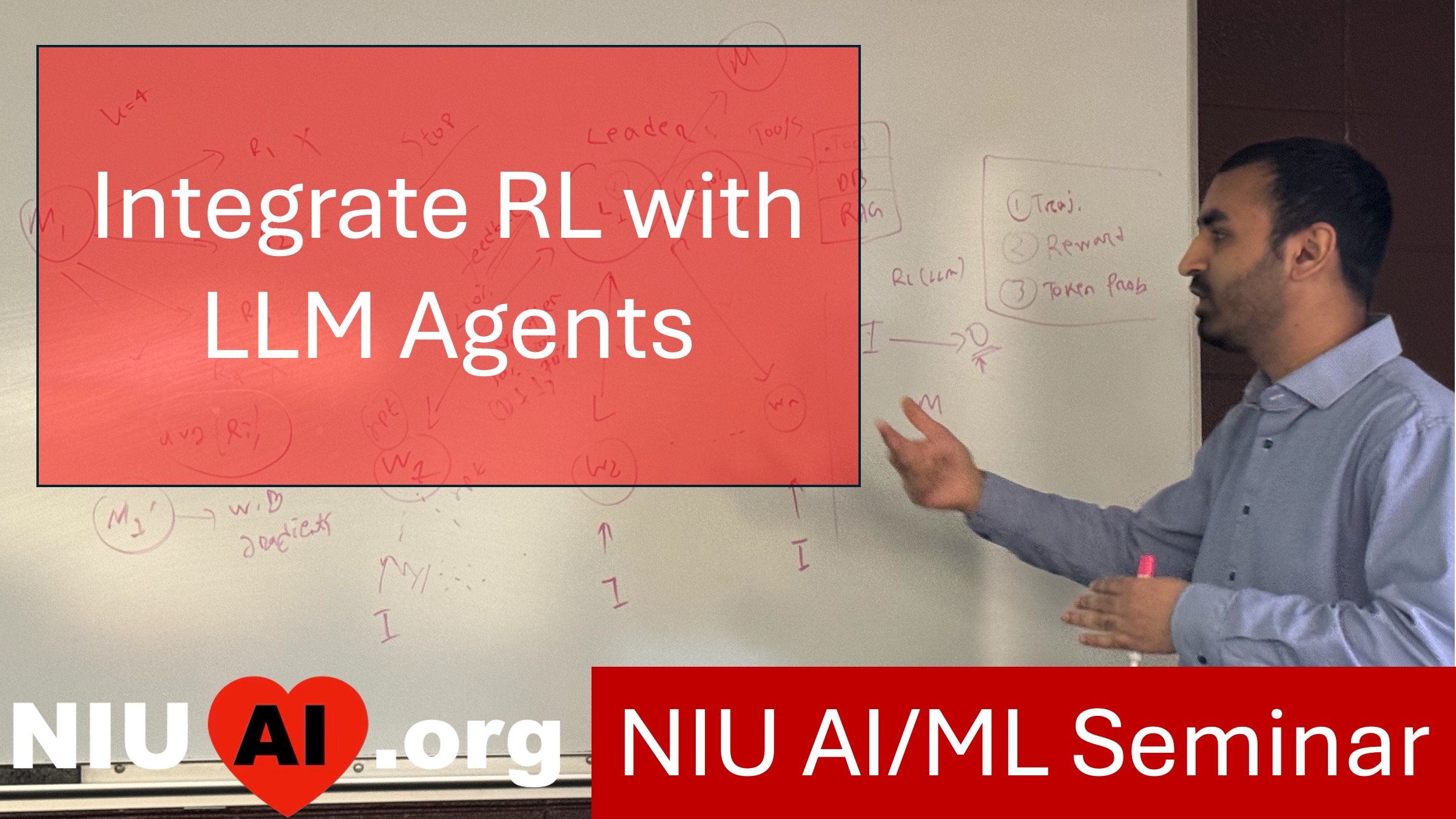
Integrate RL with LLM Agents

Download the presentation slides Overview and Motivation Presentation on integrating reinforcement learning concepts with LLM engines to improve performance Multiple approaches exist to enhance LLM performance: in-context learning, post-training (reinforcement learning), and fine-tuning Focus on efficiently integrating RL concepts with LLMs, particularly for multi-agent systems Covers differences between reinforcement learning on LLMs versus reinforcement learning on LLM agents Addresses RL implementation in HPC systems due to memory-intensive requirements Multi-Agent System Fundamentals Multi-agent systems consist of multiple LLMs, each with specific roles and functions State acts as history, compiling all previous agent turns, context, and evidence in multi-turn systems Communication Topologies ...

February 20, 2026 · 11 min · Ibrahim Al Azher

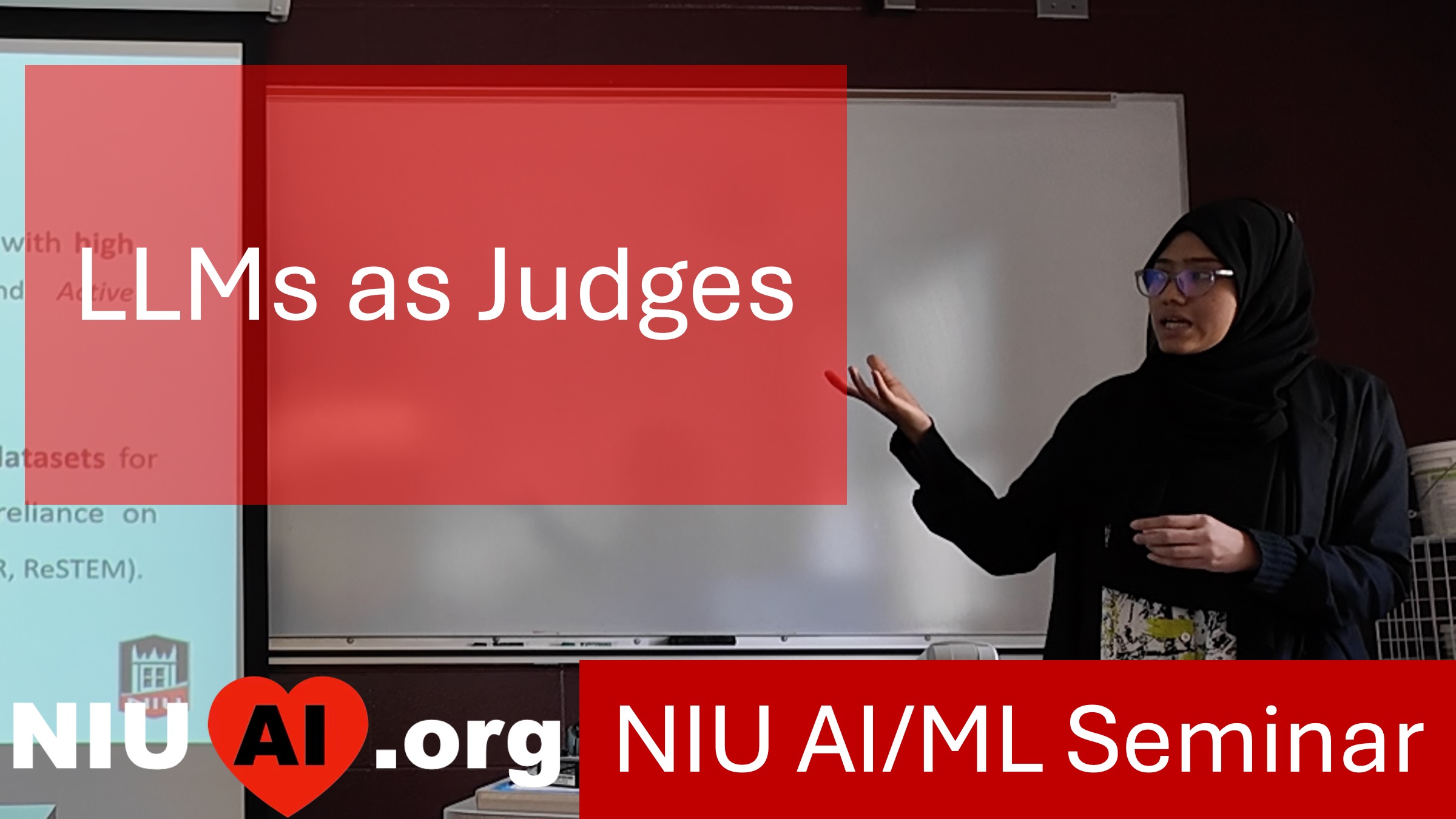
LLMs as a Judges

Overview On March 28, 2025, Miftahul Jannat Mokarrama, a PhD student in the Computer Science department, presented a research topic on “LLMs as Judges,” a trending subject in the field of large language models. Her presentation provided a comprehensive survey covering functionality, methodology, applications, meta-evaluation, and limitations. Key conclusions included: LLMs as evaluators are versatile, evaluation is context-specific, challenges persist, human-AI collaboration is essential, and evaluation should extend beyond traditional research papers.

March 28, 2025 · 1 min · Miftahul Jannat Mokarrama

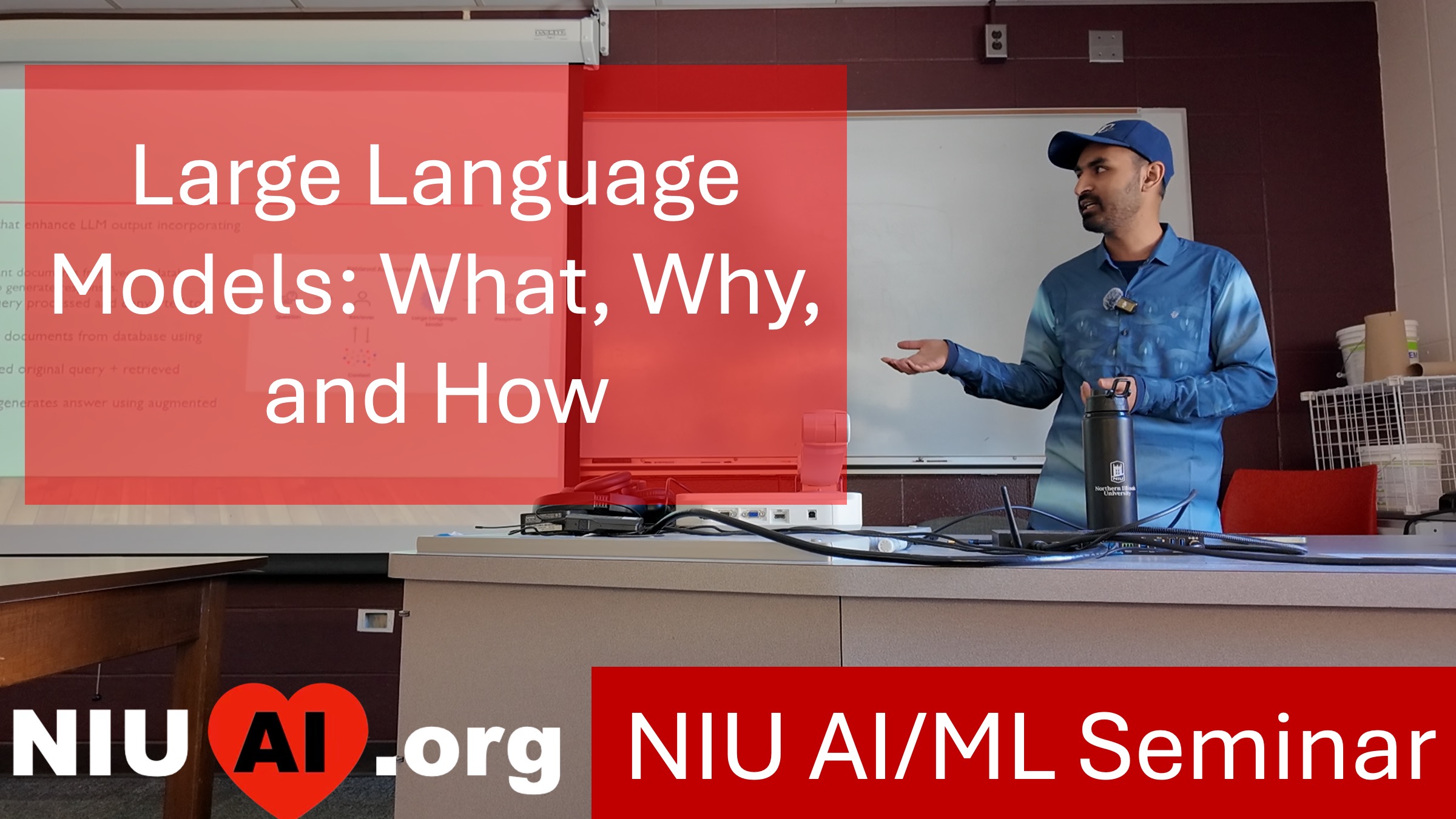
Large Language Models: What, Why, and How

Overview On 02/21/2025, the first NIU AI/ML Research Seminar was held in PM103. Ibrahim Al Azher, a PhD student from the CS department, delivered a general introduction to current studies on Large Language Models, their limitations, and recent advancements in Retrieval-Augmented Generation (RAG). The presentation, which lasted about an hour, was well received by the participants and sparked engaging discussions afterward. This event marked a successful start to the AI/ML research seminar series.

February 21, 2025 · 1 min · Ibrahim Al Azher